Archiving Teletext


How is teletext recovery still possible all these years later? Have a look for yourself!
Picture This...
Someone in the 1980s, let's say 1985, records their favorite program from CBS, NBC, or TBS onto their choice of videotape (Betamax or VHS). After the program, they might use that same tape to record other programs, but once it's full, onto the shelf it goes. What this person might not have realized is that besides recording a TV program, they recorded something else that they couldn't visibly see on their TV screen, something that has seemingly become forgotten here in the U.S.: teletext.
Wait... Really?
It's true! Most people have likely transferred a videotape in their lives, whether it's a home movie or a TV broadcast. I (the creator of this site) have done my fair share of videotape transfers going back to 2011. Like most people who have transferred videotape, I only assumed the only content on the tape was the programming content I was transferring. It wasn't until around 2025 when I realized just how much I was missing by transferring videotape the usual conventional way, which for me was transferring to a DVD recorder, then importing the files onto my computer.
How, Though?
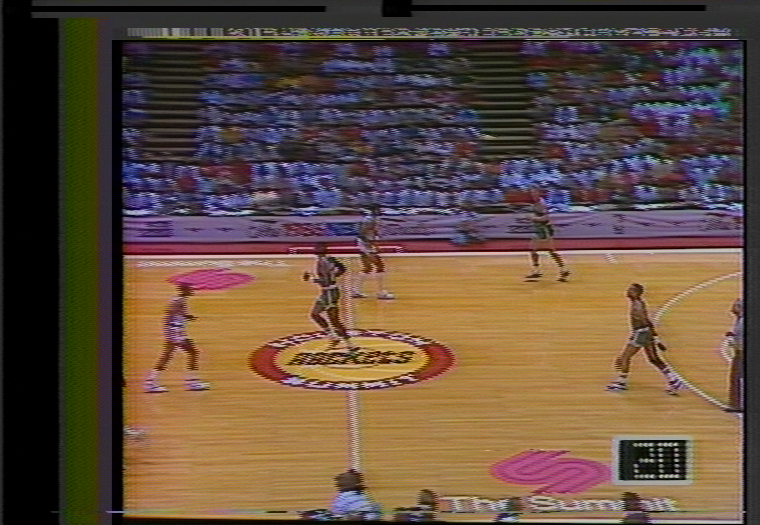
In the days of analog TV, there was an unused portion of the video signal called the vertical blanking interval (VBI). TVs normally do not show the VBI, so many don't know it's there. The VBI can hold things such as C E A dash six oh eight closed captioning (sometimes called Line 21 captions since these captions were on Line 21 of the VBI), vertical interval timecode (VITC), test signals, and even data. I'm not going to go into the specifics of what the VBI is, so I'll link the Wikipedia article for that. There's also a great lecture video on YouTube uploaded in 2022 by the U.K.'s Centre for Computing History that discusses what teletext is and how it can be recovered from old videotapes.
When a program was recorded to videotape, not only was the program itself recorded, but the VBI was recorded as well. Whatever was present in the VBI at the time of the recording was preserved in the videotaped recording. This means that, if recording a program with Line 21 captions, those captions remained in the recording. Moreover, this means that if someone recorded a network with a teletext feed, such as TBS, the teletext was also preserved in the VBI.
Some high-profile teletext services include CBS' ExtraVision, NBC's NBC Teletext, and Keyfax/Electra, the previous two being included in TBS's VBI, with Electra replacing Keyfax in the mid 1980s. ExtraVision and NBC Teletext used a standard known as the North American Broadcast Teletext Standard N A B T S, while Keyfax/Electra use the pre-existing World System Teletext (WST) standard.
Wait, What Are Those?
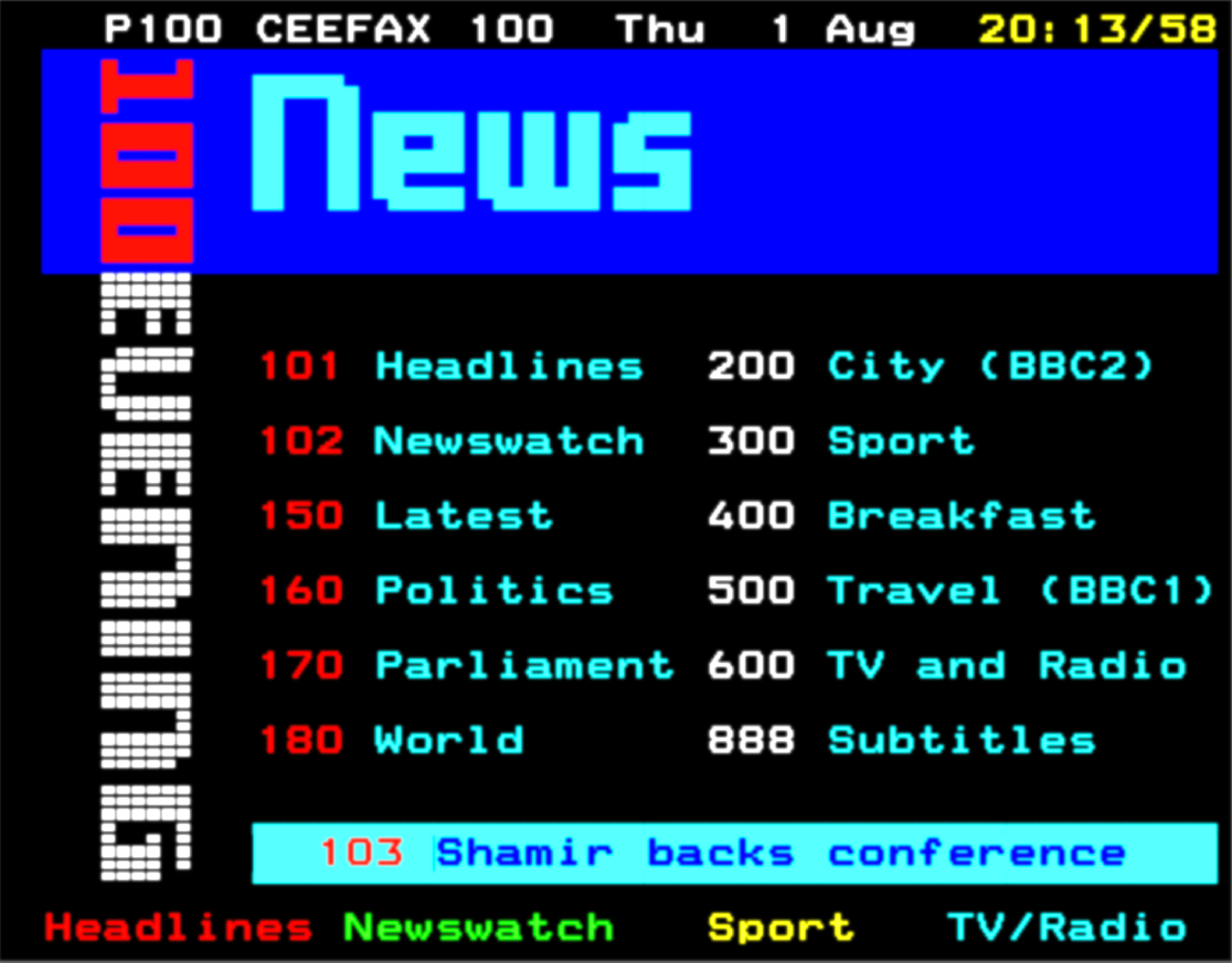
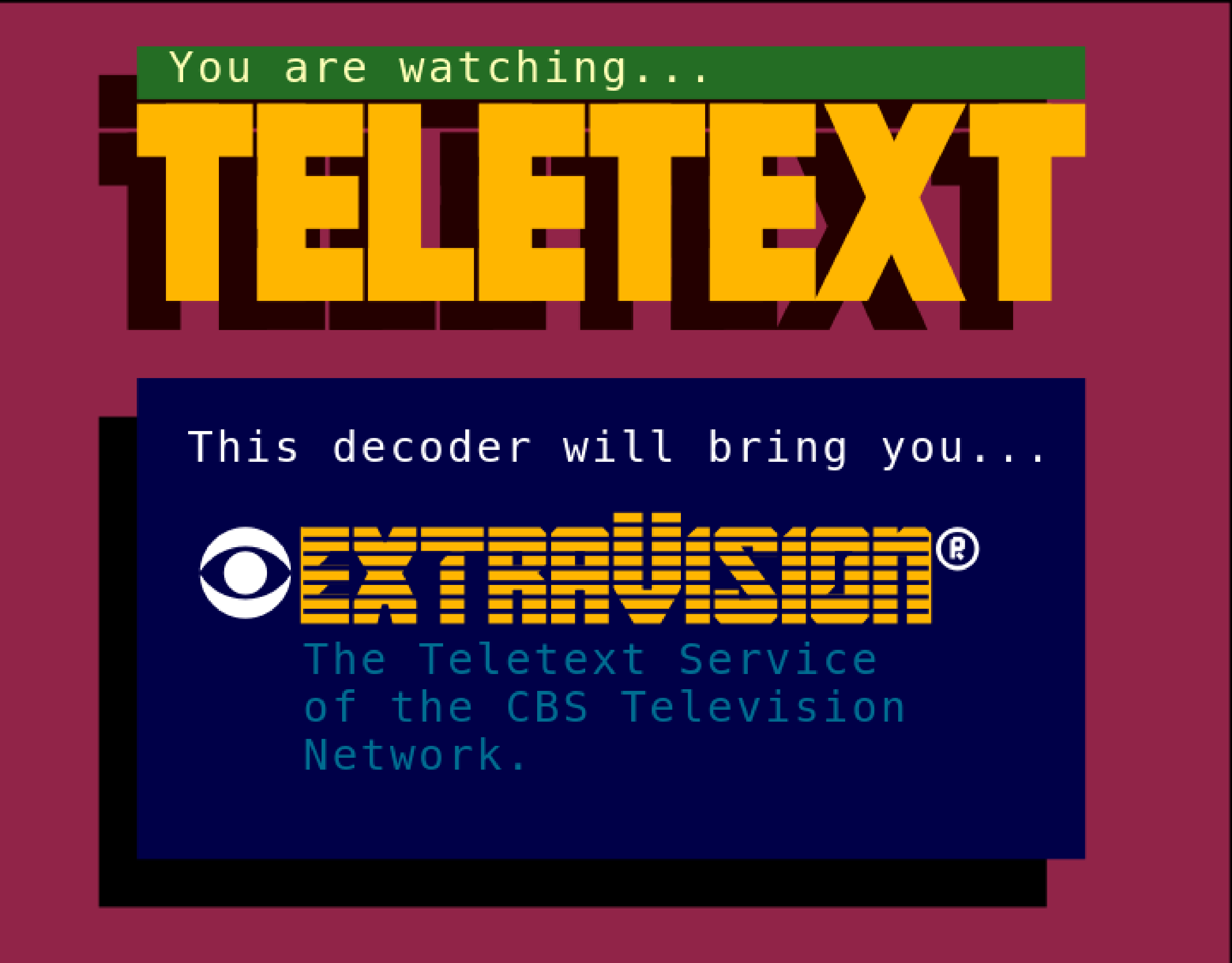
Those are the different standards used here in the U.S.; Europe only used the WST standard. A big difference between the two standards concerned the graphical capabilities. WST relied heavily on text, while the N A B T S relied on both text and graphics. To that point, the graphical capabilities of N A B T S services exceeded WST services.
WST (Electra/Keyfax)
N A B T S (CBS/NBC)
To learn more about teletext in North America, including some differences between N A B T S and WST, give J.B Crawford's great newsletter, "Teletext in North America" a read.
Do Capture Cards Work?
It sort of depends. Your standard, extremely cheap USB capture device, such as an EZ Cap, will not work. Transferring tapes via a DVD recorder will also not work. While this method does preserve the closed captions, it doesn't preserve the VBI itself. There are certain older Hauppauge WinTV capture cards that, when used with Linux, can grab the VBI, but according to someone familiar, this can be "hit or miss".
How Do I Get Started?
The best way to preserve the VBI when transferring videotape is by transferring videotape via the FM RF method using software tools such as VHS-Decode; the wiki on the GitHub repository contains a section for tapping into the FM RF test ports on various VCR models and provides steps for getting started, including the needed hardware
After the FM RF transfer, the produced file, a U8 file (sometimes manually compressed to FLAC) will need to be decoded. These are not video files as FM RF capture does not transfer conventional video like a standard capture device. Rather, it transfers the raw FM video signal on the videotape; audio is also transferred, but separately from the FM signal. Again, refer to the VHS-Decode GitHub wiki for more information.
During the decoding process, this will produce several files, but
the important one is a TBC (time base correction) file. From there,
you can use VHS-Decode's built-in ld-analyse tool to
view the TBC file, which will show the decoded video; from there,
though, the video needs to be exported and merged with the separate
audio file, but once again, refer to the wiki. Additionally, there
is another, more recent software tool called
Decode-Orc Both software tools support
decoding various data in the VBI, such as Line 21 CC and VITC, but
if decoding teletext,
this is the software to use, as it supports both N A B T S and WST standards. The
teletext part of the software, while officially released, is still
under development. As more members of the tape archiving community
use the software and discover bugs and other issues, the software
will improve over time.
Will All My Tapes Have Teletext?
First, to note, only CBS, NBC, and TBS had teletext services, so recordings from those services between 1982 and 1993 should (more on this in a bit) have teletext. The service date ranges are below:
- Electra (TBS) : approximately 1985 to June 11, 1993
- ExtraVision (CBS) : approximately 1983 to approximately 1990
- Keyfax (TBS) : approximately 1982 to approximately 1985
- NBC Teletext (NBC) : May 16, 1983 to approximately 1985
There were four stations that broadcast Electra over the air. These are listed below. Additionally, KTTV (Los Angeles, CA) had a WST service known as MetroText during the 1984 Summer Olympics and also broadcast Electra pages.
- WKRC-TV (Cincinnati, OH), where Electra originated
- WTVN-TV (Columbus, OH), which was co-owned with WKRC by Taft Broadcasting
- KOVR (Stockton-Sacramento, CA)
- WIHT (Ann Arbor, MI), owned by SSS (Satellite Syndicated Systems). This was also the company that uplinked WTBS for cable.
Some public broadcasting stations broadcast WST teletext to provide agricultural information. Most notable was InfoText, provided by the University of Wisconsin-Extension and aired on Wisconsin Public Television and WMVS (Milwaukee, WI). A version of InfoText, along with a magazine called DataVision which consisted of features, was broadcast with the Discovery Channel on cable by a San José, California, firm known as Data TV incorporated (Data TV also broadcast this service on KICU in San José circa 1987.) DakotaText aired on South Dakota Public Television stations from 1987 to 1995. There was also a teletext service trial in Utah, though it is not clear if it ever entered regular service or what standard was used.
International TeleText Communications of Sunnyvale, California, broadcast WST teletext information, principally news and stock quotes, beginning in the late 1980s from KICU San José (apparently replacing Data T.V.) and KHSC in the Los Angeles market. In 1993, ITC began to air teletext on all the Silver King Broadcasting stations (which aired the Home Shopping Network). These are listed below (they may not have done this for a long period of time before changing technologies).
- WBHS 50 (Tampa, FL)
- WEHS 60 (Chicago, IL)
- WHSE 68 + WHSI 67 (New York, NY and Long Island, NY)
- WHSH 66 (Boston, MA)
- WHSP 65 (Philadelphia, PA)
- WHSW 24 (Baltimore, MD - Washington, D.C.)
- WQHS 61 (Cleveland, OH)
- WYHS 69 (Miami, FL)
- KHSX 49 (Dallas, TX)
- KHSH 67 (Houston, TX)
With TBS being a national service, it's safe to assume that almost any TBS recording from approximately 1982 to approximately 1993 will have teletext. (It may not if recorded in the Atlanta area, because Electra was distributed by the group that uplinked WTBS/TBS for cable companies nationwide. If you see channel 17 references in promotions, don't expect teletext!) However, CBS and NBC are different; before assuming that any recording of programming from those two networks will automatically have teletext, there are a few important things to note.
1.) Local vs. National Programming
The national broadcast networks (ABC, CBS, FOX, NBC) do not provide a 24/7 schedule of programming. To make up for time when no programming from the network is being aired, affiliates fill these time slots with locally produced content, nationally syndicated content, and local news coverage. Even during network programming, stations insert local commercials and promotions.
It is our experience that most stations did not "bridge" the network VBI during local time and thus only broadcast teletext when carrying a network feed. Even during prime time, teletext data would drop off every time a station aired a local promo, commercial, or plug for its local news.
What this means is that the teletext services from CBS and NBC were not always being broadcast 24/7 on most local affiliates. Teletext data was relayed 24/7 on owned & operated (O&O) stations, stations that the broadcast networks, as the term suggests, owned and operated. We know that CBS O&O stations did this, but we do not yet know if NBC did the same thing. The five CBS O&Os of the 1980s were WCBS-TV New York, KNXT/KCBS-TV Los Angeles, WBBM-TV Chicago, WCAU-TV Philadelphia, and KMOX-TV Saint Louis. These stations likely had consistent teletext information, as did the three affiliates that broadcast local Extravision: WBTV Charlotte, WIVB-TV Buffalo, and KSL-TV Salt Lake City. Note that CBS sold KMOX-TV in 1986, at which time it became KMOV, so we do not know if it continued to bridge the VBI. We list these stations on the homepage as we are looking for more samples from these stations.
2.) Affiliate Takeover of the VBI
Not all local affiliates are alike, we all know that. In some ways, that's a good thing because each station is unique. However, concerning teletext, that can be a bad thing. Why? Take a look at the two photos below. These are photos showing the VBI from two networks: CBS (via WHAS, Louisville, KY) and NBC.
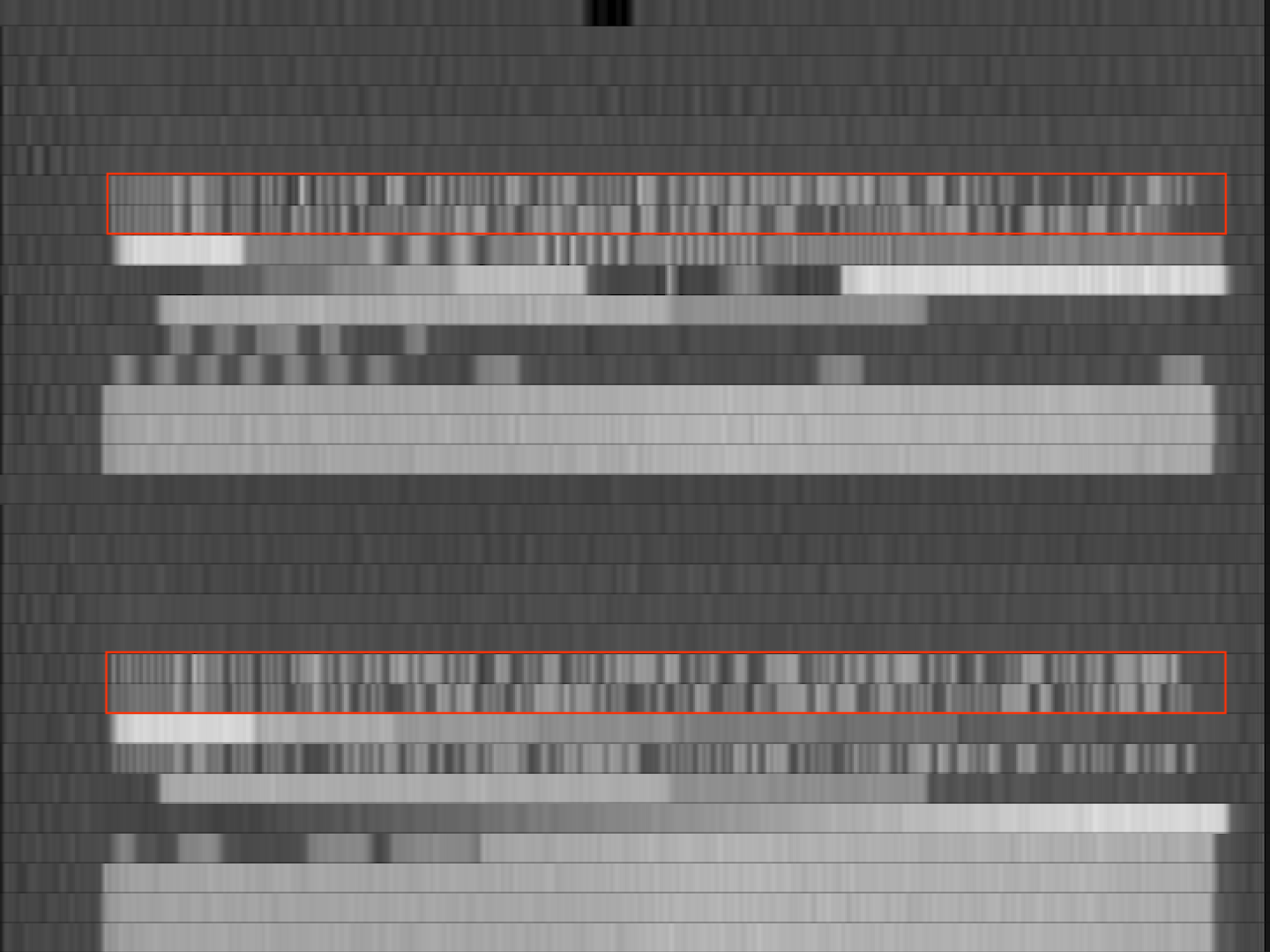
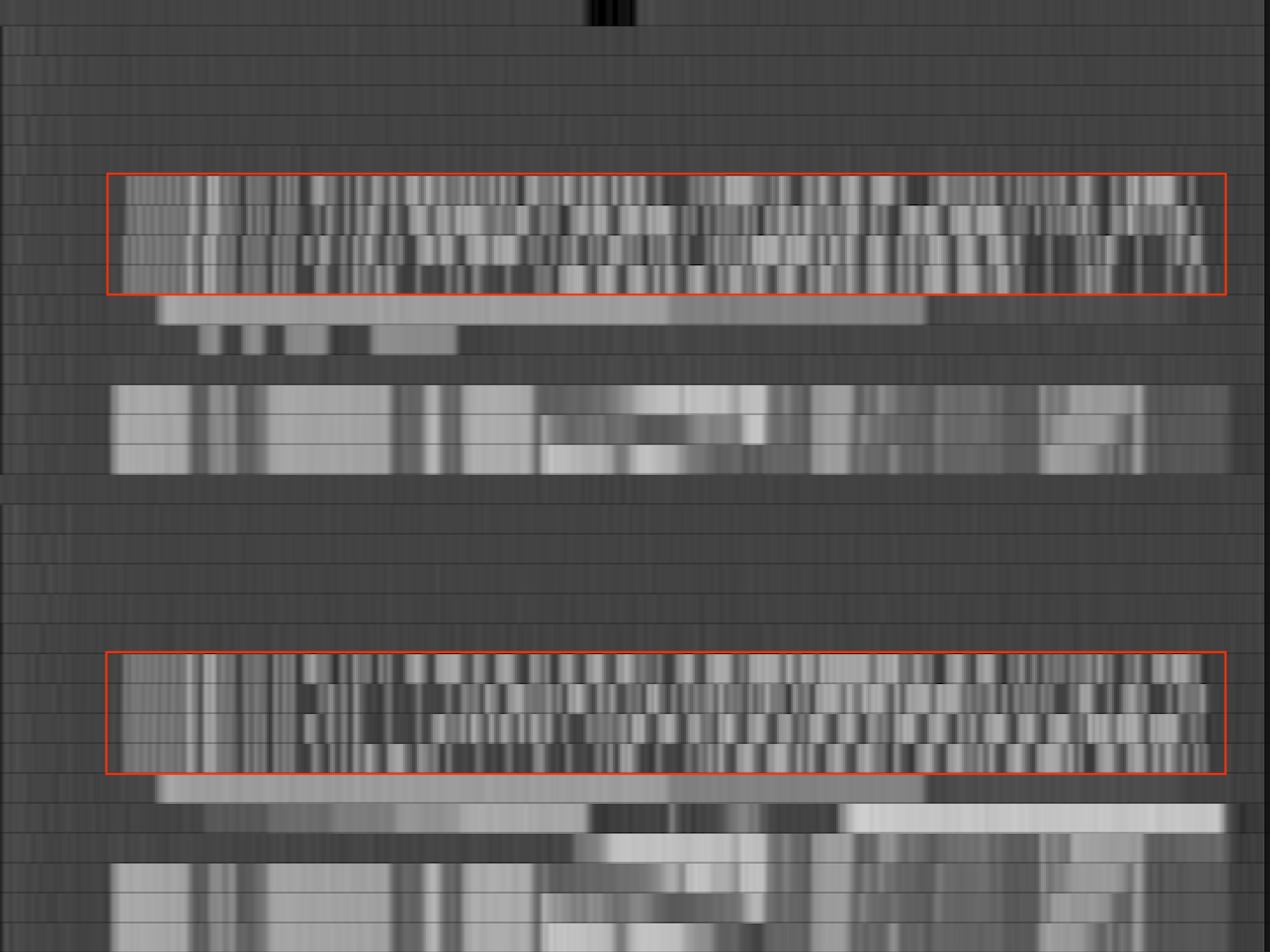
To make spotting the difference clearer, I added some red borders to the VBI images. For those using screen readers, I'll describe the difference. In the WHAS VBI, there are only two lines of teletext in both the top and bottom portions, while the NBC VBI has four lines in both portions. In a nutshell, the NBC VBI is carrying the full teletext service (NBC Teletext, in that case), but the WHAS VBI is not — this is not what you want to see if archiving teletext.
Unfortunately, some affiliates would insert their own data into the VBI, such as VITS (vertical interval test signals), which would replace, in this case, some of the teletext VBI lines. To get a clean decode of all pages in a teletext stream, the full VBI must be present. Decoding teletext from a partial VBI, like in the WHAS VBI photo, is possible. In fact, you can get a few clean pages from it. However, you will likely not be able to recover every page from the stream without the recording having the full, untouched VBI. For an in-progress list of stations that altered the VBI (that we know of so far), visit this page.
3.) Late Implementation by Affiliates
If you happen to have early recordings from CBS and NBC from around the time their services launched (refer above for date ranges), there's a chance that your affiliate didn't pass through any of the teletext data. Maybe they were a little too late to the party. Later recordings are your best chance for finding teletext, though that doesn't mean that no affiliates passed teletext through the VBI early on; I'm sure some did, especially the O&O stations, but it's hard to say which did and which didn't.
How Can I Find Out?
There isn't much of an easy way to find out unless you have access to an old analog CRT TV that allows for adjusting of the vertical hold, allowing you to see the VBI on the tape. Digital TVs do not show the analog VBI and no conventional capture card will either. However, you can see the VBI if you have a CX card from Conexant, such as a Bt8x8 card. Oscilloscopes may also work as well.